
Architecture Tradeoff Analysis Method. Systematic approach to find architectural risks, tradeoffs and sensitivity points.
Description
The ATAM method consists of four phases as shown in the diagram “Approach of ATAM”.
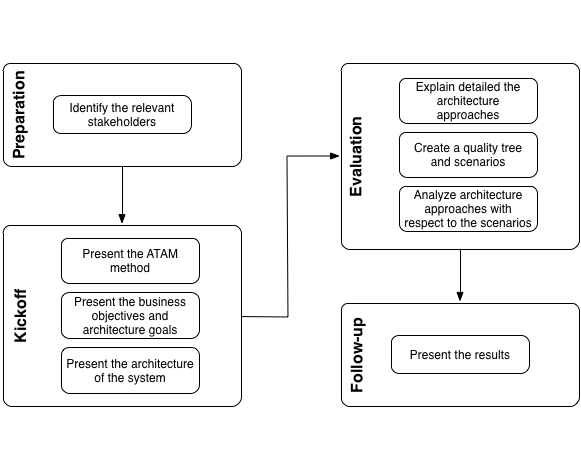
The phases are:
- Preparation
- Identify the relevant stakeholders: The specific goals of the relevant stakeholders define the primary goals of the architecture. Who belongs to these relevant stakeholders has to be determined by a Stakeholder Analysis.
- Kickoff
- Present the ATAM method: Convince the relevant stakeholders of the significance of comprehensible and specific architecture and quality goals. ATAM helps identify risks, non-risks, tradeoffs and sensitivity points. Calculation of quantitative attributes is not subject of this method.
- Present the business objectives and architecture goals: Present the business context to the relevant stakeholders, especially the business motivation and reasons for the development of the system. Clarify specific requirements that the architecture should meet, for instance flexibility, modifiability and performance.
- Present the architecture of the system: The architect presents the
architecture of the system. This includes:
- all other systems with interactions to the system,
- building blocks of the top abstraction level,
- runtime views of some important use cases,
- change or modification scenarios.
- Evaluation
- Explain in detail the architecture approaches: The following questions
are answered by the architect or developers:
- How are the relevant quality requirements achieved within the architecture or the implementation?
- What are the structures and concepts solving the relevant problems or challenges?
- What are the important design decisions of the architecture?
- Create a quality tree and scenarios: In the context of a creative brainstorming the stakeholders develop the relevant required quality goals. These are arranged in a quality tree. Afterwards the quality requirements and architecture goals of the system are refined by scenarios which are added to the quality tree. The found scenarios are prioritized according to their business value.
- Analyze the architecture approaches with respect to the scenarios:
Based on the priorities of the scenarios the evaluation team examines
together with the architect or developers how the architecture
approaches support the considered scenario. The findings of the analysis
are:
- existing risks concerning the attainment of the architecture goals,
- non-risks, which means that the quality requirements are achieved,
- tradeoff points: decisions that affect some quality attributes positively and others negatively,
- sensitivity points: elements of the architecture that have formative influence on the quality attributes.
- Explain in detail the architecture approaches: The following questions
are answered by the architect or developers:
- Follow-up
- Present the results: Creation of a report with:
- architectural approaches
- quality tree with prioritized scenarios
- risks
- non-risks
- tradeoffs
- sensitivity points
- Present the results: Creation of a report with:
Experiences
The ATAM method:
- provides operational, specific quality requirements,
- discloses important architectural decisions of the system,
- promotes the communication between relevant stakeholders.
Important: The ATAM method does not develop concrete measures, strategies or tactics against the found risks.
ATAM has been successfully applied by many organizations to a variety of systems. It is widely regarded as the most important systematic approach to qualitative system/architecture analysis.1
Applicability
Evaluate an architecture:
- as soon as possible,
- already in the construction phase,
- better not after the completion of the system.
-
The original authors of ATAM call it an evaluation method, whereas aim42 classifies ATAM as belonging to the category of analysis practices. ↩